Showing posts with label Character Arc. Show all posts

Wednesday, November 2, 2016

What Gives with Character Arcs?

I'm being a little tricky today: I'm in two places at once. Sharing about my move to Brisbane and my next adventure, I'm with Denise Covey. And, sharing a couple of truths about myself and one naughty lie, I'm over at Crystal Collier's blog where you have a chance to win an ebook copy of Cling to God! I'd love it if you could visit both awesome blogs.

IWSG question of the month:  What is your favorite aspect of being a writer? 

Being able to find clarity of thought and creative expression through the written word, and sharing that with others. How about you?

Please welcome Crystal Collier here today sharing her new book and some writing tips!

In 1771, Alexia had everything: the man of her dreams, reconciliation with her father, even a child on the way. But she was never meant to stay. It broke her heart, but Alexia heeded destiny and traveled five hundred years back to stop the Soulless from becoming.

In the thirteenth century, the Holy Roman Church has ordered the Knights Templar to exterminate the Passionate, her bloodline. As Alexia fights this new threat—along with an unfathomable evil and her own heart—the Soulless genesis nears. But none of her hard-won battles may matter if she dies in childbirth before completing her mission.

Can Alexia escape her own clock?

Add to Goodreads
Buy: Amazon, Barnes and Noble


What Gives with Character Arcs? 

Thank you for having me here today, Lynda!

As you become a seasoned writer, you slowly master a whole slew of issues. First is getting actual words on a page. Next is translating the story in your head onto the page. Once you've written a WHOLE BOOK (!!!), you blissfully believe it's the best thing on the planet, until someone kindly tells you it isn't. And that's the moment a writer either gets off the horse, or learns the buiz.

That's when we learn the intricacies of plot, and as we're about to discuss today, character.

One subject I don't see very many people discussing online is character arcs. Every main character should have their own arc. (Including antagonists.) This is just like a plot arc.


  1. The protagonist starts out with status quo.
  2. Plot: Status quo is disrupted. Character: Reacts to status quo changing.
  3. Character tries to get back to status quo, or a new sense of normal.
  4. Conflicts keep the character from reaching their goals.
  5. No matter how hard the character fights, they are completely defeated.
  6. Character find the strength to start again, usually with a reversal of what they first wanted in the story.
  7. Character builds toward achieving their new goal.
  8. Character faces a crisis that forces them to make a key decision leading to the end.
  9. Climax: Big battle brings out the best or worst in the character.
  10. Character has achieved a new sense of normal.
There are the mechanics, so what does this look like when applied to an actual story? Let's try it with Goldilocks and the Three Bears.
  1. Status Quo: Goldilocks is taking a jaunt in the woods.
  2. Status quo interrupted: She sees a house in the middle of the woods. Strange.
  3. Character tries to get back to status quo: She knocks on the door to see if someone is home, to discover what kind of weirdo lives in the middle of the woods.
  4. Conflict keeps the character from reaching their goal: No one answers. 
  5. Character is defeated: She goes inside to have her question answered and sees the porridge.
  6. Character starts again: Now she forgets about her original inquiry and remembers that she's hungry. Goldilocks tries the porridge in her investigation. She's burned, chilled, and then at ease.
  7. Character builds toward achieving their new goal: Sated, she tries each chair. Now she's just looking for comfort and has forgotten her original intent.
  8. On to the beds, and she finds exactly the comfort she's looking for in the last one.
  9. Climax: The bears return home and Goldilocks is terrified. She runs away.
  10. Character has achieved a new sense of normal: She never returns to the home of the three bears.
Character arcs are AS intrinsic or more so than a plot arc. They're like the music portion of a musical. A MUSICAL wouldn't amount to much with just a script. The music is what makes you FEEL the story. If you want satisfied readers, the characters had better make the full journey from start to finish.

Just for fun, I'd like to show you how Status Quo is broken in each of my books:
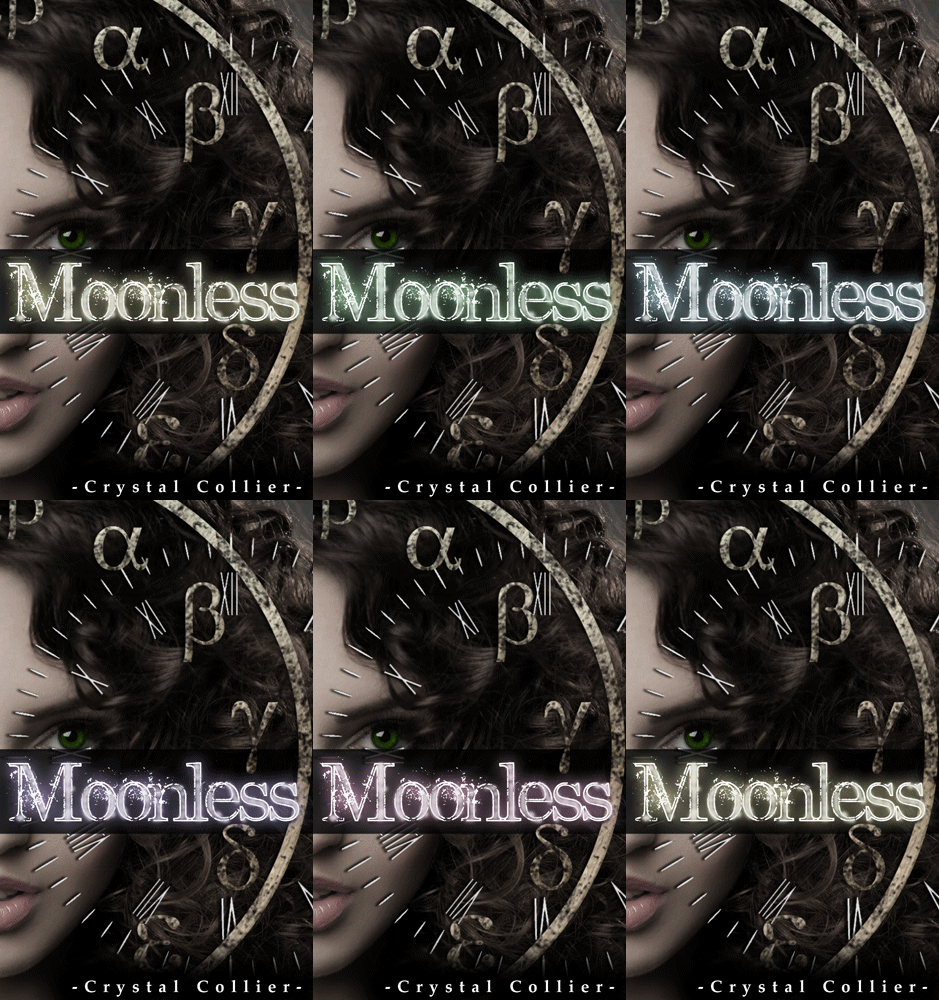
In the beginning of MOONLESS, Alexia's status quo is disrupted by an unexplainable murder and everyone abruptly forgetting about it, except for her.


In SOULLESS, her status quo is broken when she flees from her home forever to escape the Soulless and a group of Passionate who have come to kidnap her.


In TIMELESS, Alexia has thrown her own world out of whack by stepping into a time where the Knights Templar are trying to wipe out her bloodline.


We all want to see the change in people. It's fascinating. It's what makes our lives worth living.

Do your characters make the full journey?


Crystal Collier is an eclectic author who pens clean fantasy/sci-fi, historical, and romance stories with the occasional touch of humor, horror, or inspiration. She practices her brother-induced ninja skills while teaching children or madly typing about fantastic and impossible creatures. She has lived from coast to coast and now calls Florida home with her creative husband, four littles, and “friend” (a.k.a. the zombie locked in her closet). Secretly, she dreams of world domination and a bottomless supply of cheese.


(Email address is required for awarding prizes.)


Don't forget to visit Denise and Crystal!

Thursday, January 12, 2012

6 Reasons to Write Flawed Characters

It's so tempting to write the perfect character: the dream man, the rugged hero, a character who could grace the catwalks of Milan, knows exactly what's going on, can solve anything. But it never turns out well. One element every character must have is a flaw. And here’s why:

1. Credibility. No one is perfect. No one is good all of the time and no one is bad all of the time. It’s just not real. We all have multiple flaws, both internal and external.

2. Likeability. A likeable character is an interesting character and they are usually interesting because of their flaws.

3. Relatability. We can relate to characters with flaws. It’s easier to care for a character we can relate to. We may yell at them for making stupid mistakes*, but that’s part of the joy of reading about them. That relatability draws the readers into the story and keeps them there.

4. Conflict. Flaws get characters into trouble which can add tension to a scene and build much needed conflict in the plot.

5. Uniqueness. If we all wrote perfect characters, they would lack distinction. I think part of what makes us unique is our different combination of flaws.

6. Growth. Growth and development are essential to the main characters across the course of a story. Flaws give the writer this opportunity.

Can you think of other reasons to write flawed characters? What are some flaws you've used?

*make sure they learn from those mistakes and don't keep making the same mistakes.

Monday, September 5, 2011

10 Stages of Story Development

1. The idea. It could come from anywhere. It could start with a character, a place, a scene, or simply a vague concept. I often have more than one idea, especially when I’m actively looking for them. I’ll write down all my ideas in a notebook.

2. World-building. Sometimes the idea will start with the world first. If I fall in love with the setting/world then I will pursue it further and set up the history, the politics, the ‘rules’. Even if these details don’t make it into the story, they are important to think about. The world will often dictate what kind of story it wants to tell.

3. Character development. I start thinking about the characters and give them names, appearances, traits and desires. Sometimes the characters will come before the world, depending on where the idea starts.

4. Character arc. For me the main element that drives my stories is character so I think about the character arc early on. This is where the plot begins to develop.

5. Outline. This is where I work out a beginning, middle and end. I used to just wing it, but I found I had to do a lot of rewrites to get it right. Outlining reduces those rewrites and it helps me to see the big picture before I get caught up in the specifics.

6. First draft. This is the mad frenzy of pushing out the story onto the page. I usually set myself a goal of 7000 words per week if I’m being kind to myself, or 10 000 words per week if I want to push myself. I prefer to push myself, because my best writing happens when I don’t have the time to over think everything.

7. Break. This is where a break is essential. It’s a good time to start expanding on other ideas or to write a few short stories.

8. The read through. Also essential. I think it’s important to read through your novel from beginning to end many times over the course of development.

9. Editing. This is when I allow myself to slow down and take the time to get the wording right. I look at pacing, motivations, sentence structure, chapter length etc. 

10. Critique partners. I’ll send out my manuscript to trusted critique partners and friends. Then I repeat stages 7-10 until I’m happy with the story.

How do you develop your story ideas?

Thanks to Suze at Girl Wizard for tagging me where we were supposed to tell 10 things about ourselves, but I adjusted the rules. I’m such a rebel.

Also thanks to L. G. Smith for the 7x7 Link Award. Again, being the rebel, I have linked back to her blog, Bards and Prophets, and ask that you visit and say hi from me.


Friday, October 29, 2010

The Character Arc

We all know the perfect character in any story will only add a plastic element of make-believe like something pulled from a Disneyland parade. No one in real life is perfect and, if they appear that way, then they will bore us to death when it comes to reading an entire novel about them. We want flawed characters and we want them to overcome their inner conflicts so they can conquer their outer conflicts.

This is where the Character Arc comes in:

The Character Arc is the gradual development of the characters through the story. It’s about their inner struggles and growth reflected by the outer changes in the plot. The reason why it’s so important is because it gives depth to the characters. We want to cheer for them, we want to cry for them, and we want the novel to grab us by the heart and involve us in the story.

To plot out an Arc for a character many writers start at the end. They want to know where their characters are internally and externally so they can work out the best possible path to that point. For example, if I wanted a character to show an act of courage at the end of the novel, then the act becomes more poignant and heartening if the character starts the story with a lack of courage. Think of the Cowardly Lion in Wizard of Oz.

The change can be more subtle than the example I gave above, but it shouldn’t be a sudden change. It’s unrealistic (and a bit of a cheat) for a character to do a sudden 180. No one decides to change their ways without reason. Instead, key moments in their story will guide them to the changes they need to make.

Do you plot out the Character Arcs before you begin a novel? How detailed are your Arcs? Do you ensure an Arc is present for your secondary characters as well as your main character?